SAME WORD, DIFFERENT CHEMISTRY: THE MANY TYPES OF SUPPLEMENT BITTERNESS
Unless you’re a professional flavorist or flavor chemist, bitterness probably means one thing to you: a sharp taste on your tongue that ranges from a minor note in coffee or beer to something genuinely aversive, like unflavored BCAA powder, an antibiotic, or bile. But bitterness isn’t one thing chemically. Roughly 25 distinct receptors, called TAS2Rs, do the detecting, and different classes of bitter compounds light up different combinations of them — sometimes several at once, sometimes just one, very specifically. That’s why creatine, BCAAs, magnesium, TUDCA, and kratom don’t just taste “equally bad.” They’re bad in genuinely different ways, and each way calls for a different fix.
Not All Bitter Is Built the Same
Scientists themselves don’t classify bitterness one single way — they use three overlapping frameworks, and none of them lines up perfectly with the others.
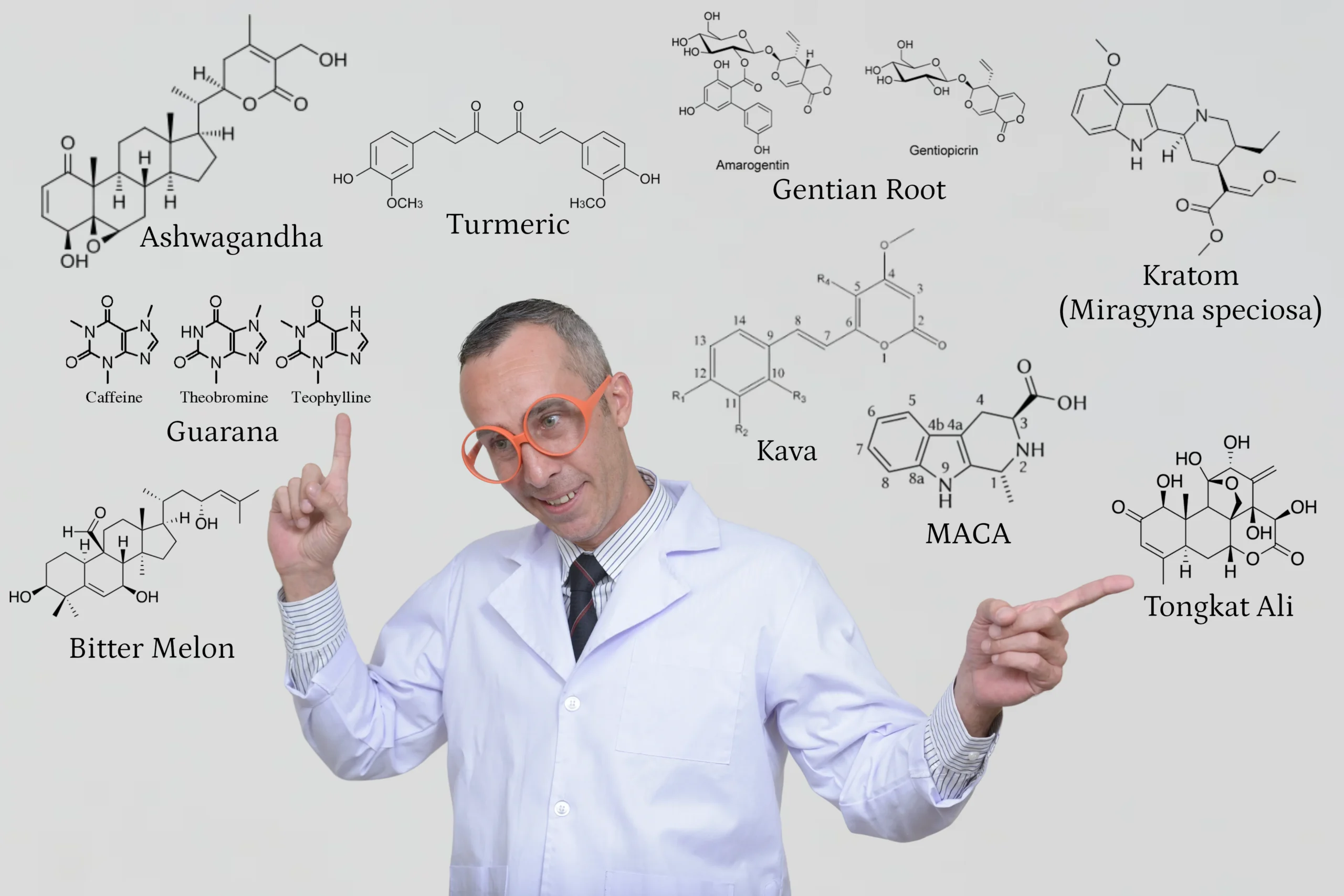
The first is chemical: sorting bitter compounds by molecular structure — alkaloids, terpenoids, glycosides, and so on. This is the most intuitive approach, but formal chemical taxonomy databases applied to bitter compounds show it’s messier than it looks. Caffeine and quinine are both textbook “alkaloid” bitterants in casual usage, but strict structural classification actually places them in different chemical superclasses.
The second is receptor-based: classifying bitterants by which of the ~25 TAS2R receptors they activate, and how broadly. Some receptors are narrow specialists that respond to only a handful of known compounds. Others, like TAS2R14, are near-universal generalists that respond to well over a hundred structurally unrelated ligands — alkaloids, flavonoids, terpenoids, and more, all through the same receptor.
The third is perceptual: how bitterness actually feels once it hits your tongue — sharp, lingering, metallic, acrid, harsh versus smooth. This is the least formalized of the three. Flavor science has only recently started building rigorous sensory panels to map these “subqualities” of bitterness, and researchers still describe the space as under-characterized.
None of these three lenses fully predicts the other two. A compound’s chemical family doesn’t tell you which receptor it hits, and the receptor it hits doesn’t fully predict how it will actually taste. That’s a large part of why bitterness masking is a genuinely hard formulation problem rather than a one-size-fits-all fix.
With that context, here are the broad chemical categories bitterness falls into in the supplements people actually take — because what works to mask it depends entirely on which category you’re dealing with.
- Alkaloids (caffeine, mitragynine, nicotine, berberine) tend to trigger multiple TAS2R receptors at once, producing a broad, intense, lingering bitterness.
- Amino acids and peptides with hydrophobic side chains (leucine, isoleucine, valine, phenylalanine) bind a narrower set of receptors, and bitterness intensity tends to track — loosely, not linearly — with how hydrophobic that side chain is.
- Terpenoids and terpene lactones (andrographolide, quassinoids, cucurbitane triterpenoids, kavalactones) are common in botanical extracts and are frequently among the most intensely bitter compounds in a plant matrix.
- Saponins and steroidal glycosides (triterpene glycosides like actein and cimicifugosides) often combine bitterness with a lingering, soapy aftertaste.
- Flavonoids and polyphenols (catechins, tannins, xanthones) often bind receptors narrowly and specifically, and frequently bring astringency — dryness, puckering — along with the bitter taste. See our full breakdown of astringency.
- Glucosinolates and their isothiocyanate breakdown products drive cruciferous-vegetable bitterness through genetically variable receptors — a different chemistry from a smell-driven sulfur note, which isn’t actually a bitterness mechanism at all.
- Bile acids and steroid conjugates, like TUDCA, are amphipathic steroid molecules that produce some of the most intense and difficult-to-mask bitterness in the supplement world.
- Mineral salts (magnesium forms in particular) produce a taste that reads as part bitter, part metallic, part chalky, through a mechanism that’s still less cleanly mapped than the others.
Here’s what that looks like in ingredients people actually take.
Alkaloid Bitterness: Caffeine, Berberine, Yohimbine, Synephrine, Guarana
Caffeine is the most familiar alkaloid bitterant in sports nutrition. It activates several bitter receptors simultaneously, which is part of why it tastes sharp and persistent rather than mild — and why pre-workouts and energy shots built around high-dose caffeine inherit the problem directly, getting worse as the dose climbs.
Berberine (from goldenseal and barberry, used in metabolic and blood-sugar support), synephrine (from bitter orange, Citrus aurantium, used in weight management and energy products), and yohimbine (from Pausinystalia yohimbe bark, used in sports and body-composition formulas) all follow the same broad alkaloid pattern.
Guarana leans on the same chemistry from a different angle: it’s bitter thanks to caffeine and theobromine, plus tannins that add astringency on top. We cover the full picture in Guarana Bitterness and Astringency, Explained and Fixed.
Kratom bitterness is frequently attributed to its main alkaloid, mitragynine — but there’s no evidence for that. Purified mitragynine is close to tasteless; minor alkaloids and other co-extracted compounds are the more likely drivers of what people call “kratom bitterness.” We cover that in more depth in Kratom Leaf Taste Explained.
Amino Acid Bitterness: Why BCAAs and Unflavored Hydrolysates Taste Rough
Free amino acids with hydrophobic side chains — leucine, isoleucine, valine, phenylalanine — taste bitter roughly in proportion to that hydrophobicity. Leucine, the most anabolically important of the three BCAAs, is also consistently the most bitter, which creates an unfortunate tradeoff: the dose that makes the product work is the dose that makes it hardest to drink.
This is also why unflavored hydrolysates taste bitter even when the whole, intact protein doesn’t. Hydrolyzing a protein breaks it into smaller peptides, and the enzymes typically used tend to cut next to hydrophobic amino acids — leaving those residues exposed at the cut ends, free to bind bitter receptors. The more thoroughly a protein is broken down for faster absorption, the more of this bitterness tends to surface.
Terpenoid Bitterness: Andrographis, Tongkat Ali, and Ashwagandha
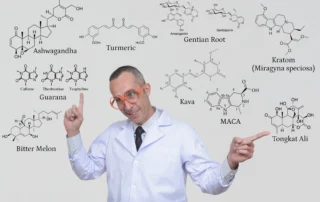
A large share of the most stubbornly bitter botanical actives are terpenoids or terpenoid-derived steroidal lactones rather than alkaloids. Andrographolide, the primary active in Andrographis paniculata, is a diterpene lactone and one of the most intensely bitter compounds used in supplements.
Tongkat Ali runs on related chemistry — its bitterness comes from quassinoids, especially eurycomanone — and it’s genuinely one of the harshest botanicals to work with, with an intensity that’s close to Andrographis or TUDCA rather than a typical herbal bitter. Full breakdown in Tongkat Ali Taste Explained.
Ashwagandha’s active withanolides are also steroidal lactones — structurally closer to a plant steroid than to a classic alkaloid — and reliably bitter enough that raw root powder is one of the more commonly complained-about tastes in the adaptogen category. Higher-withanolide extracts, which are also the more clinically potent ones, tend to taste more intense for the same reason high-leucine BCAA blends do: the dose driving the benefit is the dose driving the bitterness. More in Ashwagandha Taste Explained.
More Terpenoid Bitterness: Kava, Black Seed Oil, and Bitter Melon
Kava’s bitterness comes from kavalactones — the same compounds responsible for its calming effects — paired with an earthy, slightly chalky, drying character. Full breakdown in Kava Taste Explained.
Black Seed Oil’s bitterness comes from thymoquinone and related terpenes, while Bitter Melon’s intense bitterness comes from cucurbitane triterpenoids, momordicosides, and charantin — a chemistry it shares with other members of the cucumber family.
Mushroom extracts belong in this category too, even though people often assume their bitterness comes from beta-glucans — it doesn’t. Beta-glucans aren’t reliably bitter; the bitterness in mushroom extracts comes from co-extracted triterpenes and phenolics. More in Functional Mushroom Drinks.
Dandelion and burdock round out this category from the root-bitters tradition: both owe their bitterness primarily to sesquiterpene lactones, plus phenolic compounds in burdock’s case.
Saponin Bitterness: Black Cohosh
Black cohosh is only mildly bitter compared to the ingredients above, but it belongs in its own category chemically: its bitterness comes from triterpene glycosides like actein and cimicifugosides — saponin-type molecules that tend to bring a lingering, faintly soapy quality along with the bitterness itself.
Flavonoid and Polyphenol Bitterness: Green Tea, Turmeric, and Garcinia Cambogia
Green tea extract’s catechins, and polyphenols generally, tend to produce a dual sensation: genuine bitterness through receptor binding, plus astringency — the dry, puckering mouthfeel caused by the same compounds binding proteins in saliva. That bitter-plus-astringent combination is a large part of why concentrated green tea extract is a common complaint in fat-burner and pre-workout blends, even at fairly low doses.
Turmeric’s curcuminoids give it a milder bitterness than most botanicals on this list, layered with earthy and peppery notes from its volatile turmerones. More in Turmeric and Curcumin Taste Explained.
Garcinia cambogia is a slightly different case: most of its sour edge comes from hydroxycitric acid, not bitterness, but xanthones in the extract contribute a real secondary bitterness on top of that sourness — which is why a Garcinia formula usually needs an acid-side fix and a bitterness fix at the same time.
Cruciferous Bitterness: Maca and Isothiocyanates
Maca is technically a cruciferous plant (in the same family as horseradish, wasabi, broccoli, and mustard), and its bitterness reflects that: glucosinolates give it a mustard-sharp, slightly bitter, sulfurous edge, distinct from the bitterness patterns above. More in Maca Taste Explained.
Bile Acid Bitterness: TUDCA
TUDCA (tauroursodeoxycholic acid) and bile acids generally are amphipathic steroid molecules — part hydrophobic, part hydrophilic by design, since that’s what lets them do their job in bile. That same amphipathic structure makes them notoriously difficult to mask: they don’t behave like a clean hydrophobic alkaloid, and they produce a bitterness that’s often described as harsher and more lingering than caffeine’s. TUDCA and other bile salt ingredients are consistently among the hardest actives to formulate around in liver-support and gut-health products.
Mineral Bitterness: Magnesium and the “Chalky” Complaint
Magnesium supplements get a specific complaint that’s slightly different from the others: not sharp or lingering, but chalky, metallic, faintly bitter all at once. This is a less precisely mapped mechanism than alkaloid, terpenoid, or amino acid bitterness, but it shows up consistently enough across magnesium forms — including well-absorbed ones like magnesium glycinate — that it’s worth treating as its own category. More in Magnesium Glycinate Taste Explained.
Bitter Blockers: Fighting Bitterness at the Receptor
One approach flavor science has developed goes straight to the receptor. Instead of trying to out-compete a bitter compound with sweetness, formulators use a second compound — a receptor antagonist — that binds the same TAS2R receptor a bitterant would activate and blocks it from firing. The antagonist doesn’t need to taste like anything itself. It just occupies or disables the receptor so the bitter compound can’t trigger it in the first place.
The clearest real-world example is homoeriodictyol (HED) and its close relative eriodictyol, both derived from yerba santa (Eriodictyon californicum). On their own, these flavanones are essentially tasteless — no bitterness, no sweetness, nothing a sensory panel would flag. But they bind directly to TAS2Rs and suppress the bitterness of a range of otherwise unrelated compounds, including caffeine, quinine, and strychnine. That combination — a real plant-derived compound acting as a genuine receptor-level blocker while contributing no flavor of its own — is exactly why flavor formulators actually use it, rather than treating bitter blockers as a purely academic idea. And despite having no taste of its own, it’s still classified as a natural flavor under current regulatory definitions, since it’s derived directly from a plant source through conventional processing.
This has moved beyond flavor labs, too: a homoeriodictyol sodium mouthwash is currently in clinical trials as a treatment for chemotherapy-induced bitter taste disorders in cancer patients — real evidence that receptor-level bitter blocking is advancing from mechanism to actual medical use.
We’ll go deeper on the specific compounds and how they’re selected in a dedicated article on taste-masking approaches.
Beyond Blockers: Sweeteners, Physical Entrapment, and Flavor Matching
Receptor blockers are one lever, not the whole toolkit. Three other approaches do most of the remaining work in a well-built formula.
A calibrated sweetener system does more than add sweetness — sweet and bitter perception partially suppress each other through receptor-level cross-talk, not just competing for attention on the tongue. But sweetness alone has a ceiling: past a certain bitterness intensity, more sugar or high-intensity sweetener stops moving the needle, and it does almost nothing against astringency, which isn’t a taste at all.
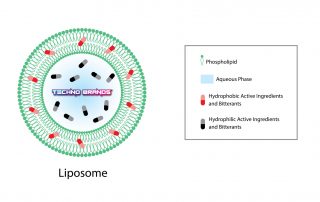
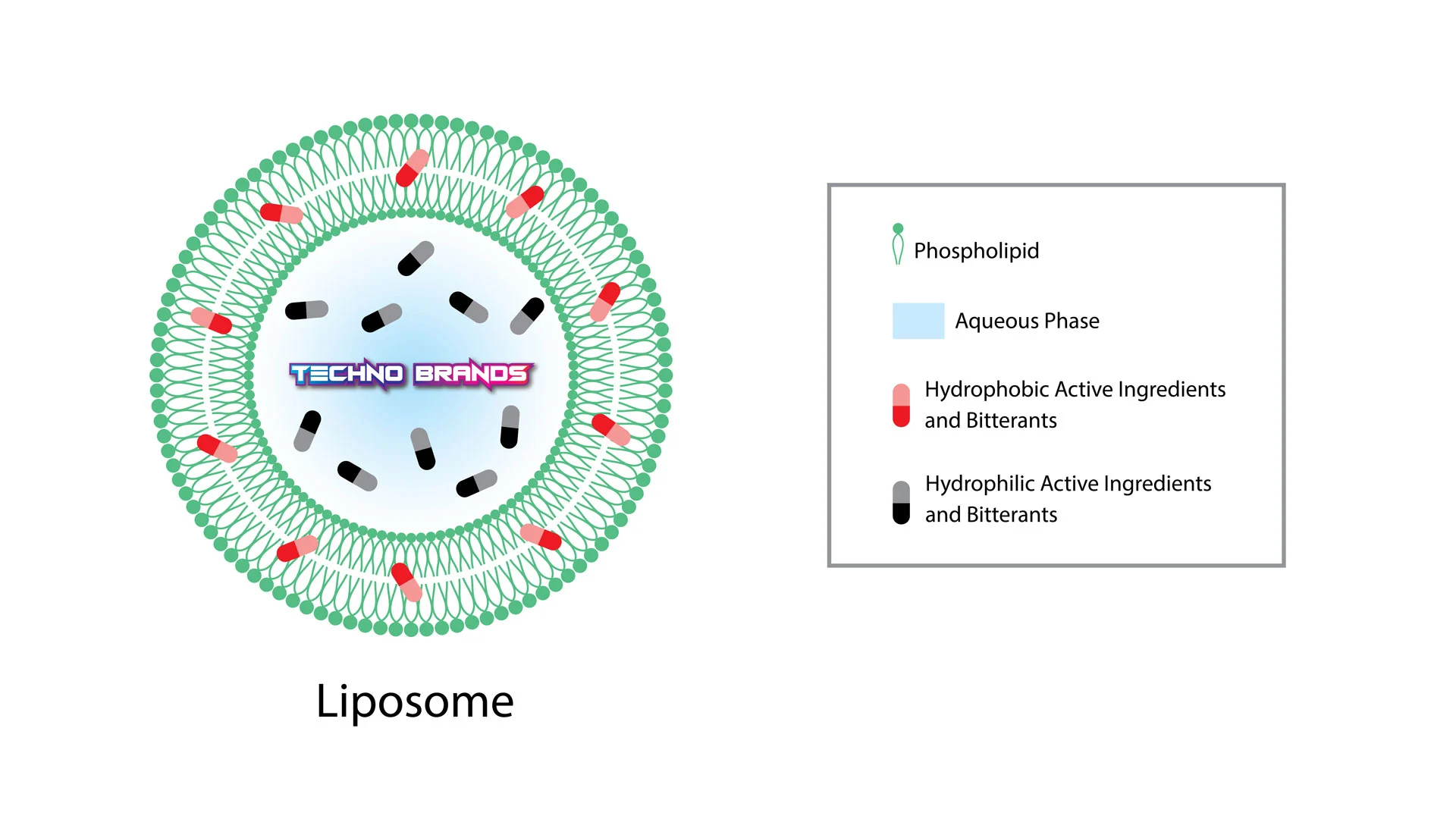
Physical entrapment takes a different route entirely: instead of competing with the bitter signal, or blocking the receptor itself, it prevents the bitter compound from reaching the receptor in the first place. Binding a bitter compound inside a lipid particle, a cyclodextrin cavity, or another carrier structure reduces its direct contact with TAS2Rs on the tongue — the active ingredient is still fully present and bioavailable, it’s just not sitting directly on the receptor the way it would in a plain solution. This works especially well against bitterants that are inherently hydrophobic, since they’re drawn preferentially into a hydrophobic carrier core.
Flavor matching is the most familiar lever and the easiest to get wrong. Certain flavor profiles genuinely perform better against certain bitterness types — dark, roasted notes like cocoa or coffee tend to hold up well against alkaloid bitterness, while brighter citrus and tropical profiles tend to perform better against amino acid and mineral bitterness. Picking a flavor that fights the specific bitterness present, rather than a generic “pleasant” flavor, is a large part of what separates a formula that works from one that doesn’t — and it’s a separate question from mouthfeel, which needs its own fix entirely.
Why Botanicals Are the Hardest Category to Mask
A caffeine-only formula has one bitterant to deal with. A cough syrup has one or two bitterants to deal with. Plant extracts are complex mixtures, and it’s common for a single botanical to contain bitterants from several of the classes above at once — an alkaloid fraction alongside terpenoid lactones, flavonoids, and trace saponins, for example. On top of that, botanicals frequently carry compounds that aren’t bitter themselves but make everything else taste worse: tannins and other astringent polyphenols amplify the perceived harshness of whatever bitterness is already present, and can trigger their own drying, puckering mouthfeel that compounds the problem. We go deeper on this in Why Most Botanical Supplements Taste Bitter.
The practical consequence: a botanical extract typically can’t be fixed with one receptor blocker and a sweetener. It usually needs several blockers targeted at the different bitterant classes actually present, a sweetener system calibrated to the specific intensity curve of that mixture, and something addressing astringency separately — stacked together, in the right ratios, without any one element undermining another. Single-lever solutions that work fine on a caffeine or creatine product tend to fail outright on a full-spectrum botanical.
Building One System That Handles (Almost) All of It
A formula tuned for alkaloid bitterness won’t touch a peptide bitterness, a mineral bitterness, or a bile-acid bitterness — let alone a botanical extract carrying several of these at once. Building a single system that performs consistently across that entire range, including messy multi-bitterant botanical matrices, is a genuinely hard formulation problem, and it’s the one TECHNO-MIXERS was built to solve. We break down exactly how — the phospholipid chemistry, the sweetener stack, and the receptor-level science working together — on our Technology page.
Ready to try TECHNO-MIXERS on your bitter supplement? Start with the Assorted Flavors Pack or check specific blogs on the supplement of your choice for flavor recommendations and tricks.