ACIDITY, SOURNESS, AND pH, IN YOUR DRINK: MAKING SENSE OF ALL THE TERMINOLOGY
Understanding the difference between pH, titratable acidity, and sourness/tartness, and why they don’t always move together, is the difference between dumping more sugar in your drink (which barely helps) and actually fixing the problem. Here we cover the chemistry and what it means for taste. For practical tips on how to take sour, acrid, or otherwise painful supplements, make sure to read the companion article.
TWO DEFINITIONS TO KNOW BEFORE WE START
- Sourness is one of the five basic taste qualities, alongside sweet, salty, bitter, and umami. It’s the perceptual response that fires when hydrogen ions activate OTOP1, a dedicated proton channel on sour-sensing taste receptor cells. Sourness is a sensory experience, not a chemical quantity, which is exactly why it doesn’t always track pH in a simple, predictable way.
- Titratable acidity (TA) is a chemical measurement, not a taste. It’s the total amount of acid present in a solution, counting both the free hydrogen ions already dissociated and the acid still bound up and available to release more. It’s determined in the lab by titrating a sample with a base to a defined endpoint pH (commonly 8.2) and reading off how much base it took to get there. As the sections below lay out, TA tracks perceived sourness far more closely than pH does on its own.
WHAT pH MEASURES AND WHAT IT DOESN’T
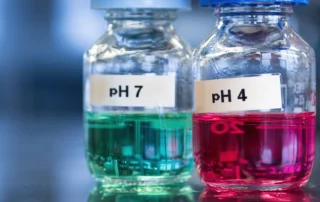
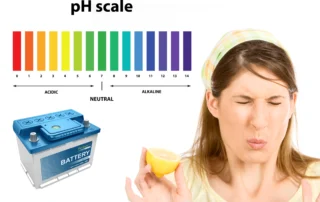
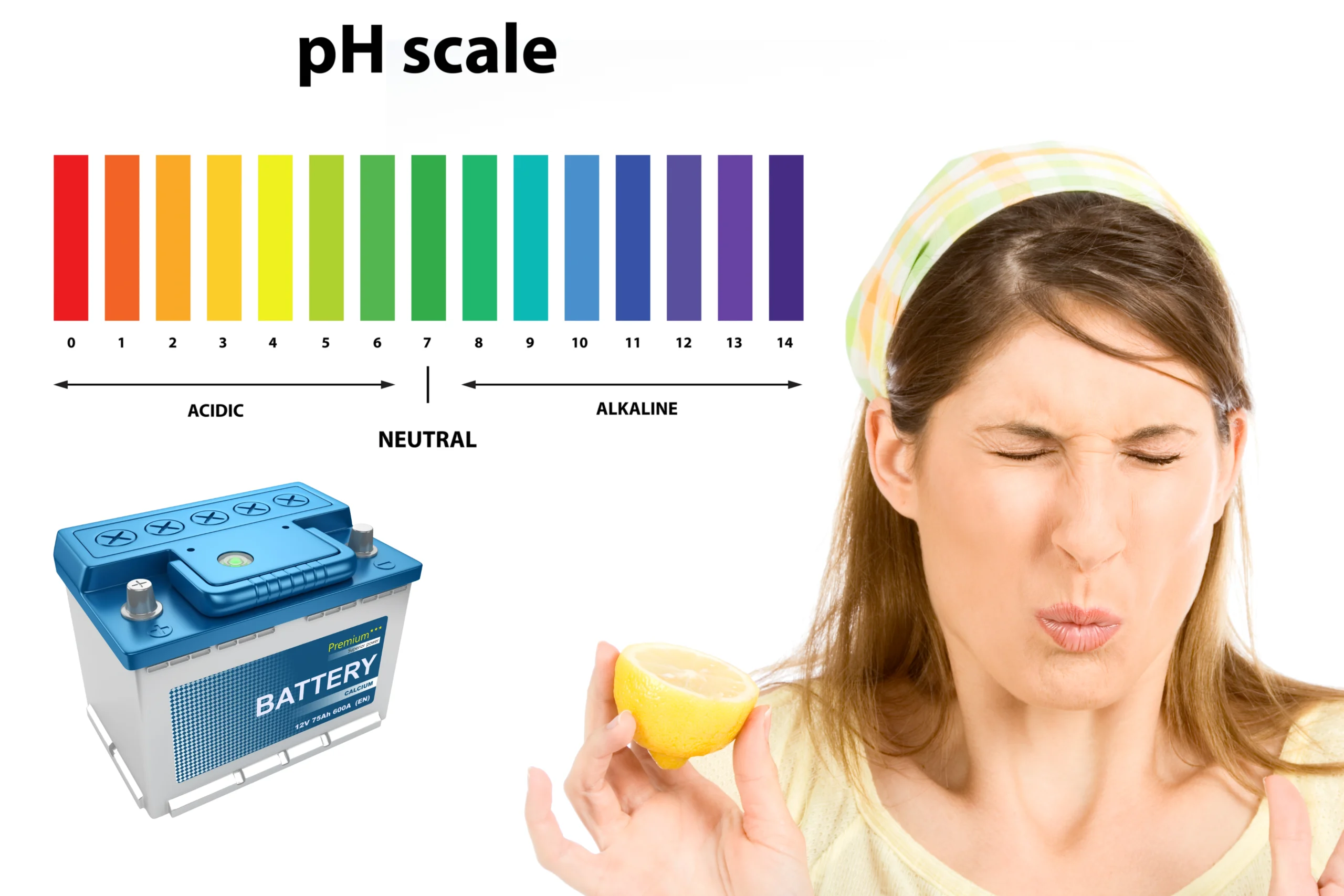
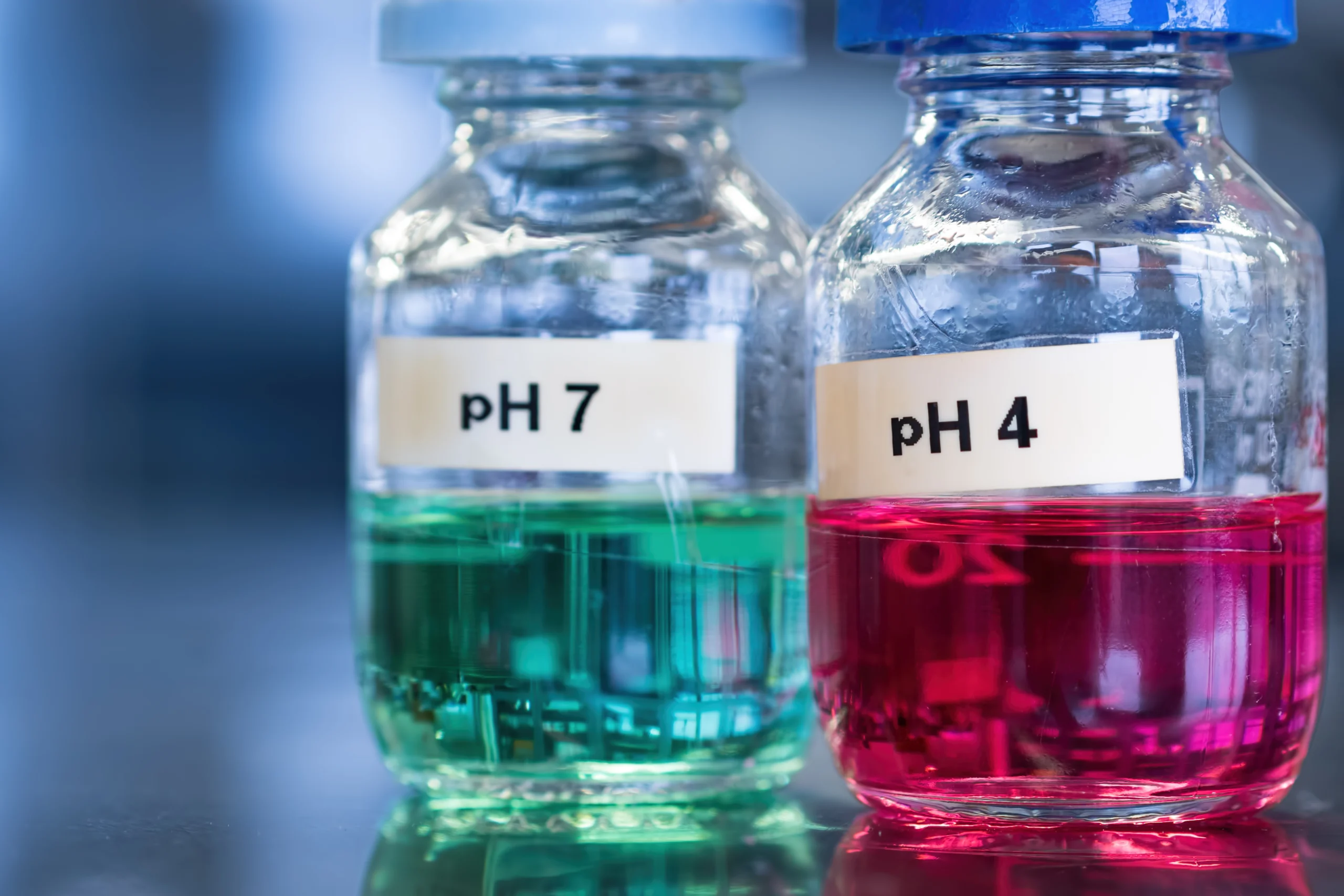
pH is a measure of free hydrogen ion (chemists write it as H+) concentration in a solution. The scale runs from 0 to 14; it’s logarithmic, so every whole-number drop represents a tenfold increase in acidity. Pure water sits at 7. Black coffee sits around 5. Kombucha typically lands between 2.5 and 3.5. Orange juice is around 3.5. A lot of liquid supplement shots — especially ones built around botanical extracts stabilized with added acid — land between 2.5 and 3.5, in the same range as vinegar and straight lemon juice.
Here’s the part most people miss: pH alone doesn’t tell you how sour something is going to taste, or how much it’s going to irritate your mouth and stomach. Two drinks can read the exact same pH on a meter and taste completely different in intensity and duration of sourness. That’s because pH only captures the hydrogen ions that are already free-floating in solution. It says nothing about how much more acid is sitting in reserve, waiting to dissociate as your saliva starts neutralizing the first wave.
TITRATABLE ACIDITY: THE NUMBER THAT ACTUALLY PREDICTS SOURNESS
The property that better predicts perceived sourness is called titratable acidity, the total amount of acid available in a solution, counting both the free hydrogen ions already dissociated and the acid molecules still bound up and waiting to release more. Food scientists have been chasing this distinction since the early 1900s, when researchers started asking a fairly basic question: when you taste something sour, are you tasting the hydrogen ion concentration, or the total acid load?
The current working model treats sour taste almost like a titration happening in real time in your mouth. Saliva acts as a mild base, and that’s not just a figure of speech — it’s three real buffer systems working together. The bicarbonate/carbonic acid system does most of the work, responsible for roughly 85% of buffering capacity in the near-neutral range, and it scales up automatically as salivary flow increases. The phosphate system contributes alongside it, and once pH drops below about 5, a protein-based buffer takes over as the primary defense — which happens to be exactly the range most acidic supplements sit in. As these systems neutralize the hydrogen ions on contact, the acid keeps dissociating to replace them, releasing more hydrogen ions to keep stimulating sour receptors. A drink with high titratable acidity keeps this reaction going longer, which is why some sour drinks feel like they linger and rebuild in intensity rather than fading — that’s the reserve acid doing its work.
There’s also a receptor-level explanation for why this matters so much, and it isn’t just about how strongly an acid affects the receptor — it’s about how the acid gets there. The sour receptor, a proton channel called OTOP1, is only one entry route. Strong acids are already fully dissociated, so their hydrogen ions go straight through OTOP1. Weak acids are only partially dissociated, which means a portion of each acid molecule stays electrically neutral and can passively diffuse straight across the taste cell membrane, then dissociate once it’s already inside the cell — acidifying the cell from within, on top of whatever is happening at the receptor. That second, membrane-permeation route is the best-supported explanation for why organic acids like citric consistently taste sourer than hydrochloric acid at the exact same pH: it isn’t a matter of degree within the same mechanism — it’s two separate mechanisms stacking on top of each other.
Practically, this means two supplement shots can have the same pH and produce very different in-mouth experiences. The one with more titratable acidity is going to taste sourer, longer, and is more likely to cause the burning or raw feeling people associate with “acidic” supplements regardless of what the pH strip says.
WHY NOT ALL ACIDS TASTE OR FEEL THE SAME
The specific acid matters as much as the amount. Citric, malic, ascorbic, tartaric, lactic, and phosphoric acid are most common in food and supplement formulation, and they don’t behave identically even at matched concentrations. It’s also worth noting that acid isn’t only added for structural reasons — in foods and drinks generally, acid is frequently added purely for taste, to match or intensify a fruit, citrus, or berry profile. In supplements specifically, though, it’s more often doing structural work first, with taste as a secondary consideration:
- Citric acid delivers a sharp, clean sourness and is the most common acidulant in botanical extracts, partly because it doubles as a mild preservative and metal chelator.
- Malic acid tends to read as sourer and more lingering than citric acid at the same pH — it’s the reason sour candy manufacturers often prefer it.
- Ascorbic acid (vitamin C) is simultaneously an active ingredient, an antioxidant, and an acidulant in many formulas, which means the “dose” of sourness is tied directly to the dose of the vitamin. You can’t reduce one without reducing the other.
- Acetic acid (vinegar) is a familiar weak-acid reference point, sharp and pungent even at low concentrations — a useful illustration of how strongly a weak acid’s taste can register despite a fairly mild pH.
- Phosphoric acid is used to lower pH without excessive sourness (Coca-Cola, for example, typically ranges from 2.37 to 2.7, primarily due to phosphoric acid and dissolved carbon dioxide) but tends to produce more astringency, a drying, puckering sensation layered on top of the tartness, distinct from the sour taste itself.
- Tartaric acid, common in grape-derived extracts, produces a sourness profile researchers have found doesn’t correlate as cleanly with titratable acidity as other organic acids do — its structure interacts with taste receptors somewhat differently.
- Carbonation adds acidity too. CO2 is itself a “sour” gas: once dissolved in water it reacts to form carbonic acid, which lowers a drink’s pH and adds its own tangy, sour edge on top of whatever acid is already in the formula. That effect is transient, though once the bubbles escape and the drink goes flat, the carbonic acid converts back into CO2 and water, and that acidic, sour bite fades, which is part of why a flat version of the same drink often tastes noticeably sweeter than the carbonated one.
This is also where strong versus weak acids come in. Every acid has a dissociation constant, Ka, describing how completely it splits into H⁺ (the hydrogen ion) and its conjugate base in water; pKa is just -log(Ka), so a lower pKa means a stronger acid. Strong acids — hydrochloric acid and sulfuric acid are the standard examples — have Ka values so large, and pKa values so far into negative numbers, that they’re essentially 100% dissociated at any concentration you’d encounter. There’s no equilibrium holding any of it back; all of it is immediately “live” as free H⁺. Weak organic acids — citric (pKa ~3.13), malic (~3.40), ascorbic (~4.10), acetic (~4.76) — only partially dissociate. Most of the acid stays in its neutral, undissociated form at any given moment, held back by that equilibrium, with only a fraction releasing H⁺ at a time.
Some of this comes down to solubility and how easily an acid crosses into taste cell membranes, and some comes down to how the specific anion, left behind after dissociation, interacts with sour receptors. These differences are exploited by formulation scientists: swapping acids, not just diluting them, can meaningfully change the sourness and irritation profile even at an identical pH.
DEALING WITH pH, ACIDITY AND SOURNESS: BASES AND BUFFERS
As already mentioned, a separate article covers practical tips for dealing with sour supplements — this is just the last chemistry lesson here. Say you have a sour supplement you have to take: what do you do? You reduce acidity — bring the pH closer to neutral — and that’s done by adding a base, a buffer, or both.
A base (or alkali) is a substance that reacts with and consumes free hydrogen ions, raising a solution’s pH. The bases you’ll actually run into in food and supplement systems are mild ones: sodium bicarbonate (baking soda), potassium bicarbonate, calcium carbonate, and magnesium hydroxide are the most common, alongside the more alkaline forms of potassium or sodium phosphate salts. Add a base to an acidic supplement and it reacts directly with the free H+ already in solution, consuming it and pushing the pH up. That neutralization also pulls on the reserve — the titratable acidity defined earlier — since the equilibrium keeps releasing more H+ to replace what was just consumed, so a base doesn’t just move the pH reading, it draws down the total acid pool too.
The problem with using a base alone is dosing precision: you either need to know exactly how much to add so you don’t overshoot into alkaline territory, or you need a pH meter or at least pH test strips to check as you go. A better option is to use a buffer, or a combination of a buffer and a base.
A buffer works differently. Instead of simply reacting with and depleting acid the way a base does, a buffer is a pair of chemical species — typically a weak acid and its conjugate base — that resists changes in pH by absorbing added acid or base within a defined range. The phosphate buffer system and the bicarbonate/carbonic acid system are the two most relevant examples in supplement formulation, and not coincidentally, they’re two of the same three buffer systems your own saliva uses to neutralize sour supplements in your mouth, described earlier. Add a buffer to a formula and it holds the pH within a target window instead of pushing it toward a single fixed endpoint, which makes it far more forgiving to dose than a base alone — overshooting into alkaline territory is much harder to do by accident.
FOR THE CHEMISTRY NERDS: THE FORMAL DEFINITIONS
We tried to keep every description in this article as simple as possible, so that someone with a minimal chemistry background could still follow what we were explaining. But if you loved chemistry back in school and haven’t touched it since, the plain-language versions above might feel like they’re skipping something. Here are the formal definitions we were simplifying.
Acid: formally, a substance that releases a proton (H+) when dissolved in water. The Arrhenius and Brønsted-Lowry definitions agree on this core idea, though the Brønsted-Lowry version (a proton donor) is the broader, more modern one. Every acid discussed in this article — citric, malic, ascorbic, hydrochloric, and the rest — fits this definition: dissolved in water, each one releases H+ ions, and that released H+ is what pH, titratable acidity, and OTOP1 are all responding to, in one form or another.
Base: the mirror image of an acid. In the Arrhenius definition, a base is a substance that releases hydroxide ions (OH−) when dissolved in water; in the broader Brønsted-Lowry definition, it’s a substance that accepts a proton. Baking soda, potassium phosphate, and the other bases and buffers described above all function this way at the molecular level — either directly supplying OH− or accepting free H+ out of solution.
Neutralization: when an acid and a base meet, the H+ from the acid and the OH− from the base combine directly to form water (H+ + OH− → H2O), and whatever’s left of the acid and base recombine into a salt. That reaction — acid plus base yields water plus salt — is neutralization in its most literal, textbook form, and it’s the exact same reaction happening, in miniature, every time a base or buffer brings a sour supplement back toward neutral pH.