WHY MOST BOTANICAL SUPPLEMENTS TASTE BITTER?
Summary
If you’ve ever taken botanical supplements in powder form, you already know the drill: most taste bitter or pungent, some are musty, earthy, or woodsy, and many leave an unpleasant aftertaste that lingers long after you swallow. Bitterness is the single most common complaint about these products — and usually the hardest one to fix.
There are countless bitter plants and there are many bitter plant chemicals that cause plant bitterness. Most bitter plants contain more than one bitterant — a molecule, or part of one, that triggers a bitter-taste receptor on your tongue. (If you want the deeper dive on how bitterness perception and receptors work, check out this article.) Botanicals often contain other compounds that make the bitterness worse, too. Below, we’ll look at why plants are bitter in the first place, which molecules are responsible, and how TECHNO-MIXERS can mask that difficult bitterness.
If you already know that you need a bitter supplement mixer, jump straight to our most versatile TECHNO-MIXERS flavors in pump bottles. In our own testing, these have worked best even on the toughest botanicals.
Lemon Curd, Orange Cream, Cherry, Strawberry & Cream, Bubble Gum, Fruity Maple, Café Mocha.
New to all this? Keep reading, and you’ll be fighting bitterness like a pro in no time.
The Big Picture of Bitter Botanicals
The story comes down to three simple steps:
- Plants defend themselves by producing toxic molecules.
- Humans (and other animals) learned to recognize these poisons through bitterness.
- Eventually, people discovered that some of these same bitter poisons, in small enough doses, could work as remedies or supplements.
Simple enough — but the details are where it gets interesting, and where you really start to appreciate how complex nature is.
Entire books have been written on this topic, and it’s genuinely fascinating. We can’t do it justice in just a few pages, but we’ll try to cover enough to be useful the next time you’re using a bitter plant as a supplement or a remedy.
Plants can nourish you just as easily as they can repel or kill you.
The easy, obvious part:
Ripe fruits and berries are built to be eaten: pleasant taste and aroma, soft texture, and bright color, all so that animals — including us — will notice them, eat them, and carry their seeds somewhere new. Before they’re ripe, though, fruits and their seeds blend in with the surrounding foliage, are tough to chew, and simply don’t taste good.
The less obvious part:
Most plants and plant parts — at least in the wild, before humans started cultivating them — are bitter, smelly, poisonous, or otherwise unappetizing, sometimes all at once. If they weren’t, something would eat them: bacteria, fungi, insects, birds, lizards or mammals. Any part of a plant that matters for its survival — leaves, wood, roots, flowers, seeds — is fair game for something hungry.
The part most people never think about:
Plants can’t run and can’t fight, so chemistry is their only defense — and their only way to attract help. Different jobs call for different chemicals.
Plants are chemical factories
Nobody has an exact count of how many biochemical pathways exist in nature, but the plant kingdom dwarfs the animal kingdom in metabolic complexity. Plants have a massive toolkit of specialized pathways for defense and adaptation, and they use it to make hundreds of thousands of compounds that animals simply can’t produce.
Plants share the same basic metabolic pathways as animals, but they also have photosynthesis — and they branch off from those pathways to make more than 200,000 unique secondary metabolites. Collectively, these plant-derived compounds are called phytochemicals, and the field that studies them is phytochemistry.
Plants use some of these compounds to attract: sugars, bright pigments, aromatic compounds, and acids draw in pollinators and fruit-eating animals.
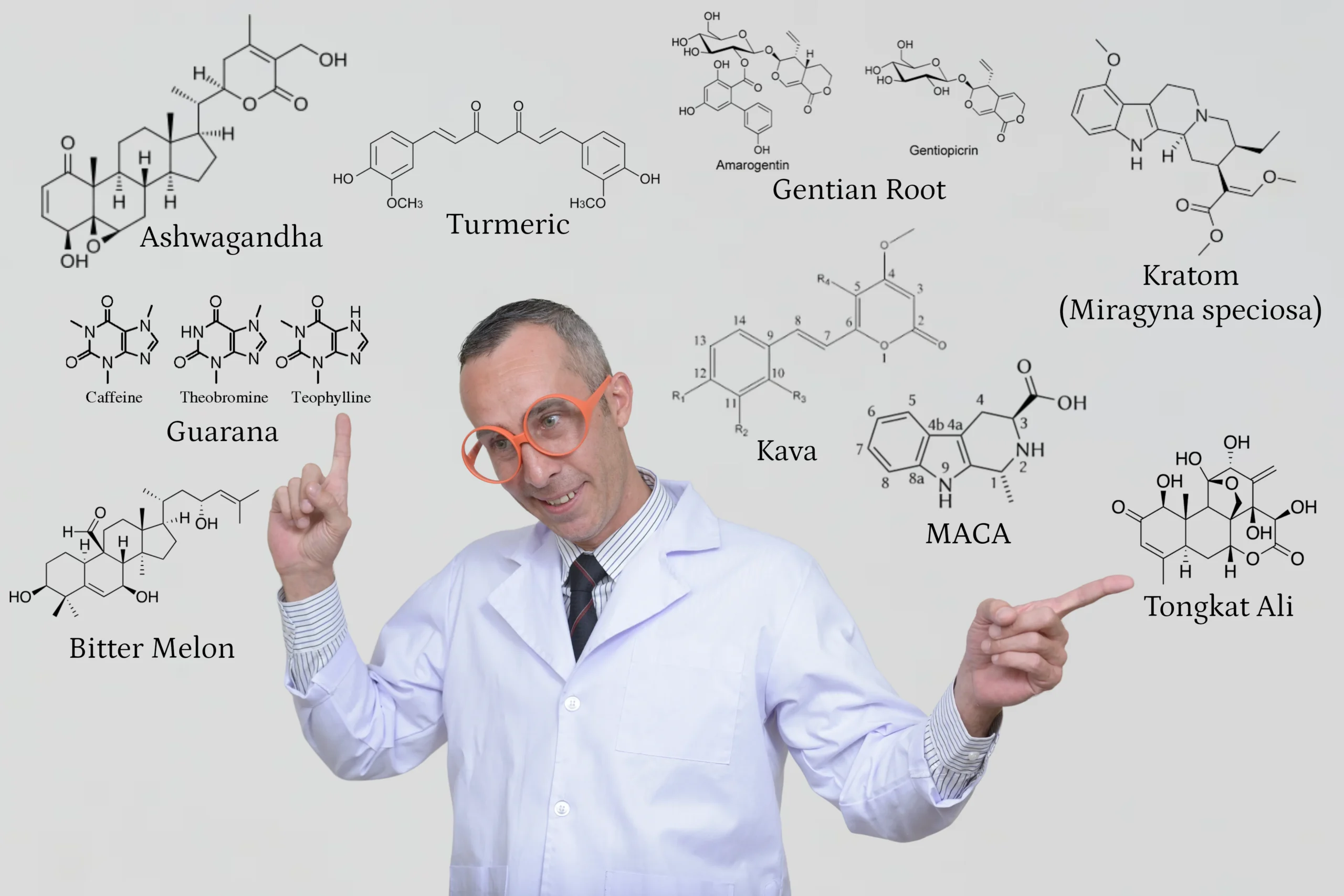
Other compounds are built to repel or kill. Mint, basil, garlic, parsley, thyme, and oregano all contain aromatic compounds that repel insects and even herbivores — yet humans find these same plants, and their chemicals, appealing. Nicotine in tobacco exists to kill insects that try to eat the plant, but humans learned to use small amounts of it for their own purposes. Caffeine in coffee and guarana likewise exists to keep insects away from the seeds; humans discovered that in small doses, it’s a stimulant and performance aid. Withanolides in ashwagandha root are natural insecticides that can damage your liver in large amounts — but in small amounts, they make ashwagandha one of the most prized adaptogens.
Dose is everything here. Take more nicotine or caffeine than your system can handle, and it will kill you — the same principle applies to most compounds found in botanical supplements.
Bitterness is a warning sign
This is where bitterness comes in, and everything above is the context you need to understand it. Humans have a sophisticated network of bitter receptors that help us recognize potentially poisonous compounds. Bitterness is essentially a warning: eat too much of this, and you might get sick — or worse.
Sensing bitterness is one of the main ways humans and other mammals judge whether a plant is worth the risk of eating. (How humans came to have that sense is a topic for another article — but we have it, and it’s helped us survive.)
Over time, people in different parts of the world discovered that some of the most bitter plants, in small enough doses, could treat real problems: reducing fever, working as an antiseptic or anesthetic, lifting mood, or stopping diarrhea. Ethnobotanical medicine is at least 5,000 years old, and it’s having something of a revival today. The key word is still “small” — the doses that produce medicinal effects are tiny compared to what you’d eat as food. Nearly every plant in the table below can kill you if you take too much, whether quickly or slowly, with a few exceptions — bitter melon, for instance, is eaten as an actual meal, though it has to be de-bittered first.
Examples of Bitter Botanicals and Phytochemicals
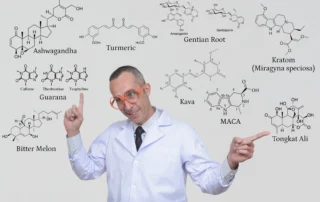
Ashwagandha owes much of its bitterness to withanolides, the same steroidal lactones responsible for its adaptogenic effects.
Tongkat Ali owes its intense bitterness to quassinoids, among the most bitter natural substances known.
Turmeric’s curcuminoids give it a mild bitterness. Maca’s glucosinolates create a slightly bitter flavor.
Kava is bitter because of its kavalactones — the same compounds responsible for its calming effects.
Kratom contains numerous alkaloids, and some of them can taste bitter. Nearly every other blog repeats the claim that mitragynine is kratom’s main bitter compound — but there’s no real evidence for that. What’s actually documented points the other way: purified mitragynine is close to tasteless. The more likely culprits are quercetin, yohimbine, reserpine, and potentially other compounds naturally present in the leaf.
In Black Seed Oil, thymoquinone and related terpenes are responsible for its bitter taste.
Bitter melon’s intense bitterness comes from cucurbitane triterpenoids, momordicosides, and charantin.
Garcinia cambogia’s bitterness comes from hydroxycitric acid and xanthones.
Guarana is bitter thanks to caffeine, theobromine, and tannins.
Goldenseal and barberry are both rich in berberine, a naturally bitter alkaloid.
Gentian root is one of the bitterest herbs around, thanks to two exceptionally bitter compounds: amarogentin and gentiopicroside.
Andrographis is well known for its intense bitterness, driven by andrographolide.
Dandelion and burdock owe their bitterness to sesquiterpene lactones.
Black cohosh is only mildly bitter, thanks to triterpene glycosides like actein and cimicifugosides.
These are all completely different molecules — they produce a similar outcome, bitterness, because each one activates a different bitterness receptor. Check out this article to learn more about them.
| Herbal supplement | Main bitter compounds |
| Ashwagandha (Withania somnifera) | Withanolides, steroidal lactones, alkaloids |
| Tongkat Ali (Eurycoma longifolia) | Quassinoids (especially eurycomanone), alkaloids |
| Turmeric (Curcuma longa) | Curcuminoids, turmerones, sesquiterpenes |
| Maca (Lepidium meyenii) | Glucosinolates, macamides (slightly bitter) |
| Kava (Piper methysticum) | Kavalactones |
| Kratom (Mitragyna speciosa) | Quercetin, yohimbine, reserpine, and other minor alkaloids (not mitragynine, which is essentially tasteless) |
| Black seed oil (Nigella sativa) | Thymoquinone, nigellone, essential oil terpenes |
| Bitter melon (Momordica charantia) | Momordicosides, cucurbitane triterpenoids, charantin |
| Garcinia cambogia | Hydroxycitric acid (HCA), xanthones |
| Guarana (Paullinia cupana) | Caffeine, theobromine, tannins |
| Goldenseal (Hydrastis canadensis) | Berberine, hydrastine, canadine |
| Gentian root (Gentiana lutea) | Amarogentin, gentiopicroside, amaroswerin |
| Andrographis (Andrographis paniculata) | Andrographolide and related diterpene lactones |
| Barberry (Berberis vulgaris) | Berberine, palmatine, berbamine |
| Dandelion (Taraxacum officinale) | Sesquiterpene lactones, taraxacin, and phenolic compounds |
| Burdock (Arctium lappa) | Sesquiterpene lactones, polyacetylenes, phenolic acids |
| Black cohosh (Actaea racemosa) | Triterpene glycosides (actein, cimicifugosides), phenolic compounds |
A Special Case of “Bitters”
Some supplements, known simply as “Bitters,” are taken specifically to aid digestion. Health practitioners are split on how they should be used: some believe tasting the bitterness is essential to getting the benefit, while others think it’s perfectly fine to take them as pills or mixed into a drink to hide the taste. (We cover this debate in more depth in a separate article, found here.)
Extraction Can Make Botanicals More or Less Bitter
Modern science can now identify the specific phytochemicals responsible for a plant’s health benefits with real precision, and modern manufacturing can extract exactly what’s needed while cost-effectively leaving the rest behind.
When the compound responsible for a plant’s benefits is also its main bitterant, extracts end up more bitter than the crude powder ever was — guarana, Tongkat Ali, and Andrographis are good examples.
The opposite can also happen: if the desired active compounds aren’t the main source of bitterness, extraction can strip away other bitter compounds and leave a milder product. Kratom and maca are good examples here. Higher-purity kratom extracts are often reported to taste less bitter, because they contain fewer tannins, flavonoids, chlorophyll, and minor alkaloids. Some maca extracts standardized for macamides taste milder too, since the extraction process leaves behind much of the glucosinolate fraction responsible for bitterness and pungency.
Combination Supplements (Stacks) and Other Contributing Factors
Ashwagandha and Tongkat Ali are each pretty bitter on their own — but combine them in one product, and the taste becomes even harder to mask. Different bitter compounds can activate different bitter-taste receptors, and when several fire at once, the bitterness comes through stronger and lasts longer. Some supplements pack in three, four, or more botanical extracts, which is exactly why they can taste so unpleasant, aftertaste included.
Smell and other sensory effects can make bitterness feel even worse. Volatile compounds create strong herbal, earthy, sulfurous, or medicinal aromas, and smell is a major part of how we perceive flavor overall. Astringent compounds like tannins bind to proteins in your saliva and leave your mouth feeling dry and rough — and that dryness makes bitterness linger and feel stronger than it actually is.
Minor compounds add another layer. Turmeric contains volatile turmerones alongside its curcuminoids; black seed oil contains several terpenes alongside thymoquinone. These minor compounds may contribute to an extract’s overall effects — but they also make the taste and aroma more complex, and harder to mask.
Are Humans More Sensitive to Bitterness Than Other Mammals?
Wildlife eats plenty of bitter plants that humans avoid — but that’s not simply because our tongues are more sensitive across the board. On raw receptor count, humans sit somewhere in the middle of the pack: we carry roughly 25 functional bitter-taste receptor (TAS2R) genes. Rodents outnumber us — mice carry around 35 and rats around 36 — which tracks with how broadly they sample plant material and how much they depend on taste to avoid poisoning themselves. Cattle carry a bit fewer than we do, around 18 to 20. Carnivores fall further still: cats have only about 7, since a mostly-meat diet doesn’t require screening for as many plant toxins, and dolphins — who swallow fish whole without chewing — have lost almost the entire gene family, down to essentially zero functional copies.
Birds and reptiles make the picture even more interesting. Most birds carry a strikingly small repertoire: chickens get by with just three functional bitter receptors, and many other bird species fall somewhere between one and a dozen. Lizards are the surprise at the other extreme — some species carry 30 or more intact bitter-receptor genes, rivaling or exceeding most mammals, likely because many lizards eat a wide mix of plants, insects, and whatever else they come across, and need the chemical screening to match.
Where humans really do stand out is with specific compounds, not bitterness in general. We’re unusually sensitive to denatonium benzoate (sold as Bitrex) — detectable at just a few parts per billion — which is exactly why it’s the standard additive used to keep people from accidentally swallowing household chemicals.
So why do humans avoid so many bitter plants that other animals eat without hesitation? The more likely explanation is behavioral, not purely sensory. Humans are broad-diet omnivores who regularly try unfamiliar foods, so a bitter-as-toxin alarm carries more survival value for us than it does for more specialized eaters. At the same time, humans are unusually good at overriding that innate aversion through learning and food processing — which is exactly how coffee, hops, and bitter greens became dietary staples, despite triggering the same rejection reflex in everyone else.
There’s also a lot of individual variation in how people experience bitterness. Researchers commonly test this with two synthetic bitter compounds, PROP and PTC, because how strongly someone tastes them is largely determined by genetics. A meaningful share of the population carries a nonfunctional version of the TAS2R38 gene and barely perceives PROP/PTC-type bitterants at all, while others are highly sensitive “supertasters.” People who regularly eat a bitter botanical may also find it gets easier to tolerate over time — whether that’s true desensitization, learned tolerance, or a bit of both.
Bitter sensitivity also tends to decline with age, which may explain why adults handle bitter foods like coffee or broccoli better than kids do.
People vary here too: some may grow accustomed to a particular bitter supplement over time, while others stay just as sensitive to that same one. And even people who do adapt to some bitter supplements will likely never get used to certain others that are simply too bitter to tolerate.
Bitterness, Daily Routines, and How Techno-Mixers Can Help
Capsules solve the taste problem for most supplements, most of the time — but not always. Fishy burps (or Butyragen burps) can surface no matter whether you took a pill or a spoonful. A bitter taste in your mouth after taking Tongkat Ali or Andrographis capsules is also common, usually caused by stomach acid backing up into your throat, or by the active compounds circulating in your saliva. And then there’s pill fatigue: some people take 50 to 100 pills a day, and swallowing them all is genuinely a lot of work.
There’s more to bitterness than taste alone. The same bitter-taste receptors that sit on your tongue are also present in the lining of your stomach and gut, and activating them there triggers real physiological effects — including increased gastric acid secretion and slower gastric emptying. That’s a documented, receptor-driven effect, not just an unpleasant taste, and it’s part of why some botanicals cause genuine stomach discomfort rather than just tasting bad. Most botanical supplements are quite safe, but at higher doses this can cause real distress — and it’s one of the leading reasons people stop taking them.
If a supplement tastes bitter or leaves an unpleasant aftertaste, it creates a second problem: compliance. Remedies and supplements only work if you actually stick with them, and herbal remedies typically need to be taken consistently for weeks to see the full effect, then for months to maintain it. In most cases, the lingering taste matters more to whether people stay consistent than most manufacturers realize.
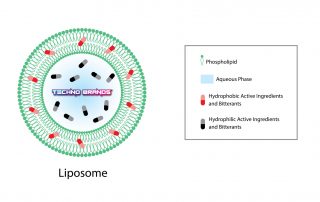
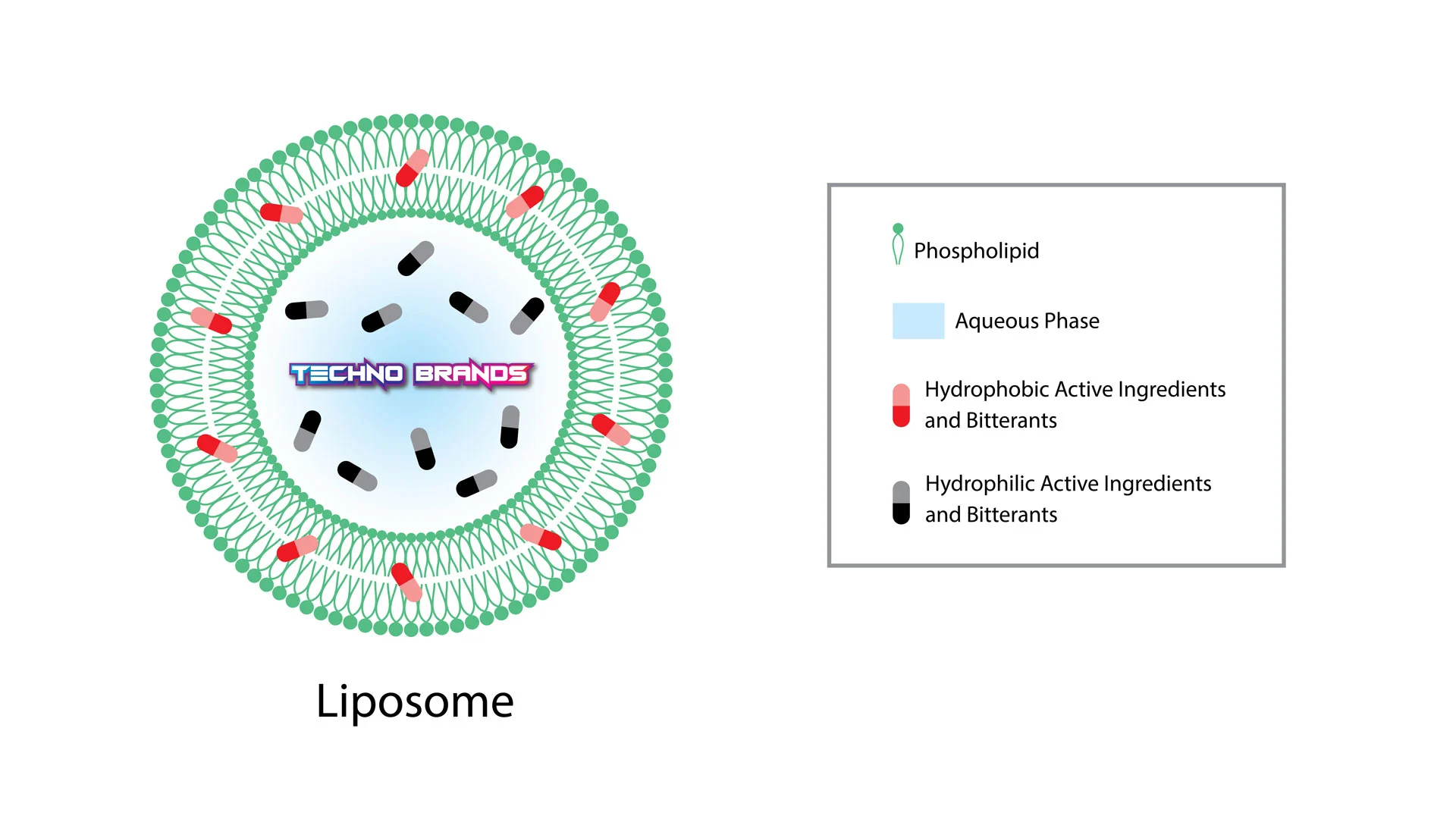
One common workaround is mixing botanicals into juices, smoothies, or yogurt. This works well for some supplements but not others — and even when it does work, it can add unwanted volume and calories. TECHNO-MIXERS were developed to solve this: low-calorie, sugar-free, all-natural, universal syrups that mask the bitterness of botanicals and help with all of these issues at once. It’s not just flavor and sweetness — it’s a scientifically designed formula that actively binds bitter molecules to phospholipids from sunflower oil, blocks bitterness receptors in your mouth, layers in sweetness, and improves mouthfeel. Flavor plays a role too, though a smaller one. And because the formula binds bitter molecules to phospholipids, it may also improve the absorption and bioavailability of your supplement.