MACA TASTE EXPLAINED: WHY IT’S BITTER, PEPPERY, AND SULFUROUS
Quick Summary
Whether you take maca as raw powder, gelatinized powder, or a standardized extract, it comes with real, well-documented taste complaints — sharp pungency, a sulfurous cabbage-like smell, bitterness, and an earthy, dirt-like base note. The full list is right below. The root cause is phytochemistry: specific sulfur-and-nitrogen compounds unique to the Brassicaceae family (the same family as broccoli and mustard), covered in full detail toward the bottom of this article for anyone who wants the science.
TECHNO-MIXERS was designed to address all of it at once — physically binding the compounds responsible for pungency and bitterness while a layered sweetener system rounds out what’s left. Cream-forward options like Café Mocha, Caramel, Orange Cream, and Strawberry & Cream pair best with maca’s natural butterscotch note, while bolder flavors like Bubble Gum, Cherry, Peach Mango, or Lemon Curd work well if you’d rather override the taste outright. More on flavor pairing further down.
If you already know which mixer you need for your Maca, here are quick links to these flavors in pump bottles. If you crave specific and original content to make the right decision, keep reading.
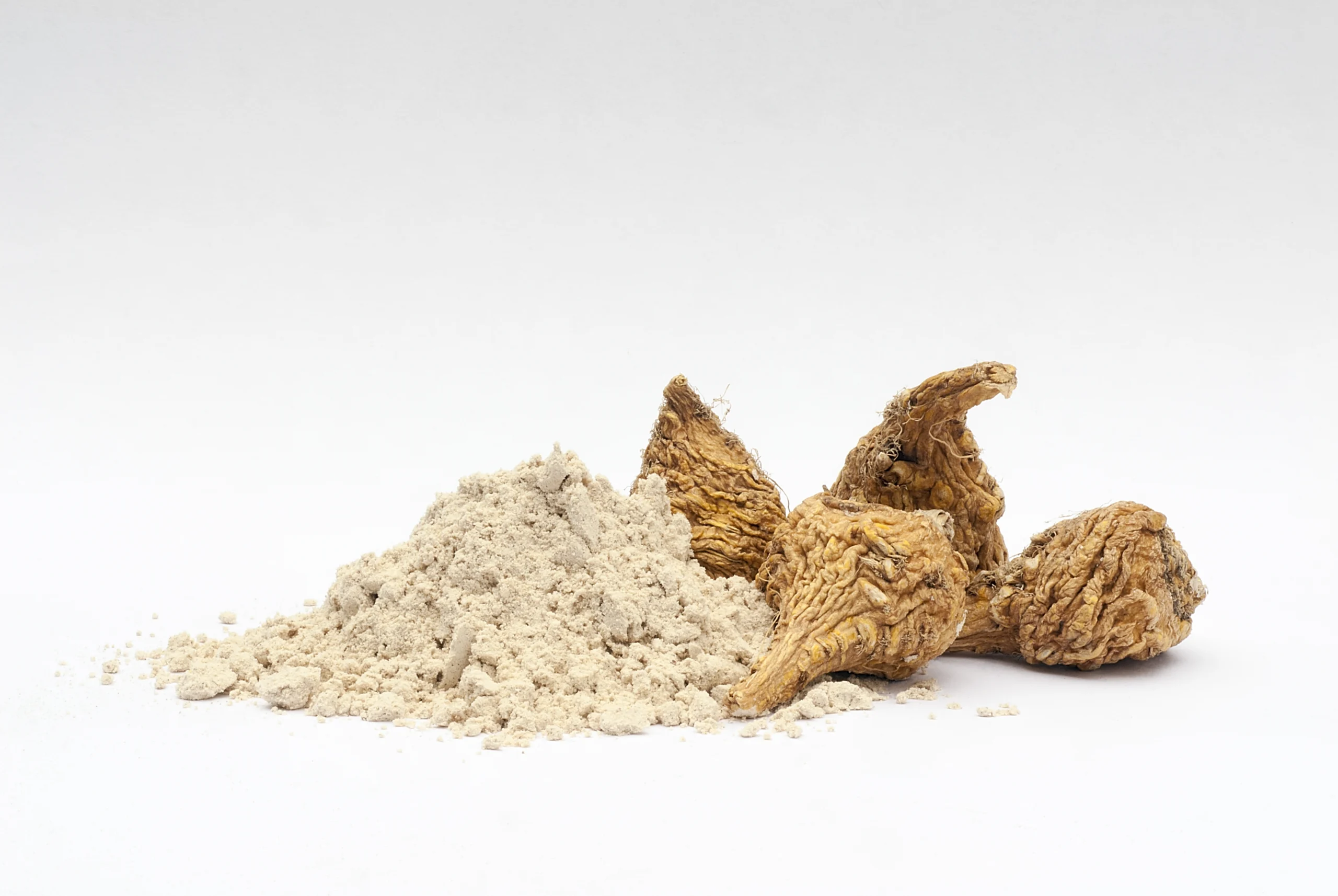
Maca (Lepidium meyenii) is a Peruvian root that’s become a staple adaptogen in the supplement world, most often reached for to support energy, stamina, and hormonal balance, with a research base spanning both men’s and women’s reproductive and endocrine health. It’s sold as raw or gelatinized powder, capsules, and increasingly as an extract standardized for its macaene and macamide content. But maca is a root vegetable, not a neutral-tasting isolate, and stirring a scoop into water or a shake tends to introduce a flavor that’s considerably more assertive than most people expect. Understanding what actually drives maca powder taste is the first step to actually fixing it, rather than assuming any sweetener will do.
Typical User Complaints
- A sharp, mustard- or horseradish-like pungency that catches in the throat
- A sulfurous, cabbage-like smell, especially when mixed into warm liquid
- A bitter aftertaste layered on top of the pungency
- An earthy, “dirt-like” base note some find off-putting on its own
- A chalky, gritty, or starchy mouthfeel when stirred into water
- Noticeable batch-to-batch variation in intensity depending on the source and processing
How TECHNO-MIXERS Can Help
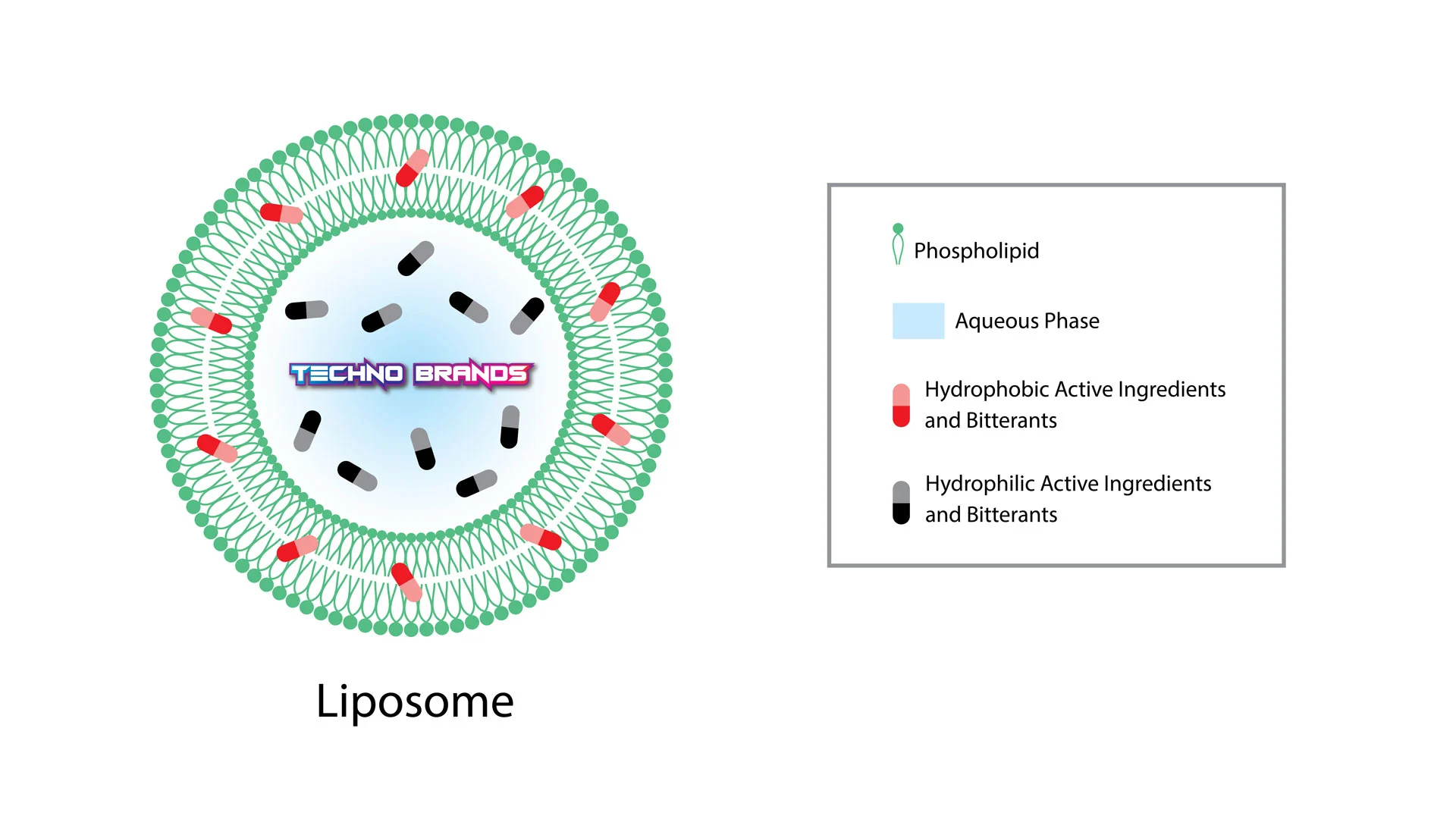
TECHNO-MIXERS’ core mechanism is physical entrapment: the phospholipids in sunflower lecithin self-assemble into liposomes suspended in water, and when they contact maca’s dissolved isothiocyanates and residual glucosinolates, those pungent and bitter species bind to the liposomes rather than making full contact with your taste buds and the trigeminal nerve endings responsible for that throat-catching sensation. Because isothiocyanates are volatile, limiting their direct release also reduces the sulfurous aroma that reaches your nose while drinking, not just the taste on the tongue.
The minor phospholipids naturally present in lecithin, phosphatidylserine and phosphatidic acid, add a second, receptor-level layer of defense: they’re documented to blunt recognition at bitter taste receptors, which matters here specifically because maca’s glucosinolate breakdown products are direct TAS2R agonists. That receptor-blocking effect works on the bitterness independently of whatever gets physically entrapped by the liposomes.
TECHNO-MIXERS’ layered sweeteners — allulose, glycerin, monk fruit, and stevia — and its natural flavor blend do double duty with maca. Because maca already carries a caramel-and-butterscotch undertone from its natural sugar content, vanilla- and caramel-leaning natural flavors don’t fight the base flavor the way they’d need to with a purely bitter ingredient; they extend maca’s own pleasant notes while the sweetener blend and receptor-blocking phospholipids handle the sulfurous, pungent top layer.
How to Take Maca: Building an Actual Maca Drink
Most people encounter three ways to take maca: stirred loose into water or a smoothie, swallowed in capsules, or taken as a few drops of liquid extract. Capsules sidestep the taste problem by trading it for a slower, less flexible dose, and liquid extract concentrates the flavor problem into a single small mouthful. For anyone who wants a real maca drink — something with volume, easy to have with breakfast or after a workout — mixing raw or gelatinized powder into liquid is the practical option, and that’s exactly the gap TECHNO-MIXERS fills: it’s the maca mixer that turns a scoop of loose powder in water or milk into something you’d choose to drink again, instead of something you tolerate for the health benefits.
TECHNO-MIXERS does more than mask flavor here. Macamides and macaenes, the compounds maca is often valued for, are lipophilic fatty-acid derivatives, and like other lipophilic actives, they don’t disperse well in a purely aqueous drink on their own — they tend to clump or float rather than staying suspended. The same phospholipid-liposome system that binds and masks isothiocyanates and glucosinolates also helps keep these lipophilic compounds evenly dispersed through the drink, functioning as a practical maca booster for the compounds maca is taken for in the first place. That’s a solubility and dispersion effect supported by the underlying chemistry — we’re not aware of a controlled bioavailability study on maca macamides specifically, so the absorption angle should be read as a plausible mechanism rather than a proven clinical claim.
Recommended TECHNO-MIXERS Flavors for Maca
Cream-forward flavors are the strongest match for maca specifically, for the same reason maca lattes and maca-vanilla protein shakes are the most common way people already consume it: a rich, creamy flavor profile complements maca’s inherent butterscotch note instead of competing with it, while the added sweetness and mouthfeel help round off the sulfurous top note. Café Mocha, Caramel, Orange Cream, and Strawberry & Cream are the best starting points for this reason.
For users who find maca’s pungency especially assertive, a bolder, more dissimilar flavor can work better than a complementary one — instead of blending with the earthy base, a bright, high-intensity flavor like Bubble Gum or Cherry can override it outright, giving the brain a strong, unambiguous flavor signal to latch onto rather than trying to reconcile a caramel note with a mustard-like bite. Peach Mango and Lemon Curd are useful middle-ground options if you want fruity brightness without going as far as a full flavor override.
Here is a link to all flavors of TECHNO-MIXERS in trial size bottles.
It is always best to start with the Assorted Flavors Pack of TECHNO-MIXERS and see which one works best for you and your supplement stack.
Why Does Maca Taste Bitter, Peppery, and Sulfurous?
The root cause is taxonomy. Maca belongs to the Brassicaceae family — the same family as broccoli, mustard, cabbage, and horseradish — and it shares their defining chemistry: glucosinolates. Maca has one of the highest glucosinolate contents of any edible plant, dominated by benzyl glucosinolate and m-methoxybenzyl glucosinolate, the same class of sulfur-and-nitrogen-containing compounds that give the rest of the Brassica family its characteristic bite.
On their own, intact glucosinolates are largely flavorless. The problem starts when the root’s cell structure is broken — by grinding into powder, chewing, or mixing into liquid — which brings glucosinolates into contact with myrosinase, an enzyme stored in separate plant cells that’s released on damage. Myrosinase hydrolyzes glucosinolates into isothiocyanates (ITCs), the same reaction that turns intact mustard seed or horseradish root into something pungent. Benzyl isothiocyanate, maca’s dominant hydrolysis product, is what’s responsible for the sharp, mustard-like pungency and sulfurous, cabbage-adjacent aroma users report — chemically related to the compound that makes wasabi and horseradish catch in your sinuses, just less concentrated.
Separately, glucosinolates and several of their breakdown products directly activate human bitter taste receptors (TAS2Rs), which is why maca reads as bitter on the tongue in addition to pungent in the nose and throat — these are two distinct sensory channels responding to overlapping chemistry, not the same sensation described two ways.
Underneath that sulfurous bitterness sits a second, more pleasant flavor layer: maca root is roughly 59% saccharides by dry weight, and the sugars and amino acids concentrated during drying and processing produce the nutty, malty, butterscotch-like base note that maca is also known for, likely via Maillard-type browning reactions similar to what happens when other starchy roots are dried or lightly roasted. That’s why maca’s flavor is usually described as a mix of two opposing things at once — a caramel-adjacent sweetness sitting underneath a peppery, sulfurous bite — rather than being simply “bad.” That combination of pungency, bitterness, and buttery sweetness is what most people mean when they describe maca taste, and it’s why sweetness alone rarely fixes it.
Processing changes the balance but doesn’t erase it. Gelatinized maca — pre-cooked to break down starch for easier digestion — tends to taste smoother and less raw than plain powder, but this is primarily a starch and texture effect rather than a glucosinolate-removal step, so pungency and bitterness can still vary noticeably by batch, root maturity, and how the powder was dried.
Does Standardized Extract Taste Different From Whole Root?
Maca is increasingly sold as an extract standardized for macaene and macamide content rather than as raw or gelatinized powder — and unlike turmeric, where concentrating the extract concentrates the same molecule responsible for the bitterness, maca’s case runs the other way. Macamides and macaenes are lipophilic fatty-acid derivatives, typically isolated using nonpolar solvents such as petroleum ether. Glucosinolates, by contrast, are polar, sulfur-rich, hydrophilic compounds that require a different extraction chemistry (aqueous ethanol or methanol) to concentrate efficiently. Because the compounds worth standardizing for and the compounds responsible for the bad taste sit at opposite ends of the polarity spectrum, an extraction process tuned to maximize macamide and macaene yield doesn’t automatically concentrate glucosinolates the way curcuminoid extraction concentrates curcumin.
A second factor points the same direction: myrosinase, the enzyme that converts glucosinolates into pungent isothiocyanates, is well-documented as heat- and solvent-labile and is commonly inactivated during the drying and extraction steps used to make a standardized extract. In raw powder, myrosinase is intact and reacts the moment the root is broken up or mixed into liquid. In a processed extract, even when some glucosinolates carry through, there may be little active enzyme left to convert them into the sharp, mustard-like compounds that actually drive the pungency — so the flavorless precursor can be present without producing much of the flavor.
The important caveat is that this isn’t automatic across every product labeled “extract.” Extraction method matters more than the extract-versus-whole-root distinction itself: some commercial maca extracts are standardized to both glucosinolates and macamides simultaneously, because aqueous-ethanol extraction — the more common, less specialized method — pulls out both compound classes at once rather than isolating macamides selectively. A petroleum-ether-style, macamide-targeted extraction plausibly leaves glucosinolates largely behind; a dual-standardized ethanol-water extract does not. In practice, that means some standardized maca extracts genuinely are milder and more palatable than raw powder, while others carry forward just as much bitterness and pungency — and without a certificate of analysis or a stated extraction method, there’s no reliable way to tell from the label alone which one you’ve got. TECHNO-MIXERS remains the answer either way: for the milder extracts it’s a lighter lift, and for the ones that still taste like raw root, it does the same full-strength job described below.